
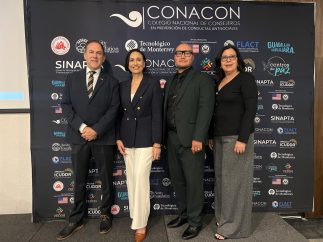
Imperial County, CA - Imperial County Behavioral Health Services (ICBHS) Director Leticia Plancarte-Garcia, joined by other ICBHS leaders, participated in an international conference held in Guadalajara, Jalisco, Mexico from Oct. 22 -24 focused on improving quality of care and access to substance use disorder treatment.
The annual conference was organized by the International Congress on Mental Health, Addiction, and Counseling. Joining Plancarte-Garcia were ICBHS Assistant Director Grabriela Jimenez and Deputy Director Jose Lepe.
Jimenez and Lepe presented on ICBHS’ efforts to expand behavioral health services in Imperial County, in particular in the area of substance use disorder care, and highlighted facility developments occurring in the county that will benefit both youth and adult services.
Plancarte-Garcia said the sharing of ideas was an important step toward building an international alliance to address substance use treatment, in particular given the unique characteristics of Imperial County as a border region.
“The conference brought all the Latin American countries together to share their knowledge and resources on what each of the countries is doing to improve the system of care for those dealing with a substance use disorder,” she said. “It showed how every country is working together to improve the quality of care they are providing.”
The conference was attended by professionals, institutional leaders, treatment providers and specialists from Mexico, the United States, Colombia, Costa Rica, Paraguay, Uruguay, and Argentina to exchange experiences and strengthen collaboration in the fields of mental health, addictions, counseling, therapeutic communities and recovery.
Addressed were issues such as new emerging substances, residential care and treatment, human rights, and humanitarian approaches to address substance use disorder through collaboration with an eye toward breaking down stigmas and treating those in need of help without judgement.
In the invite to ICBHS, it stated, “Given your leadership at Imperial County Behavioral Health Services and the important work being carried out in behavioral health in the California—Mexico border region, we would be honored to welcome you as a special guest” to the conference.
The invite further stated, “We believe your participation would represent an important opportunity to strengthen dialogue and future collaboration between professionals and institutions working in behavioral health on both sides of the border.”
Lepe said the Latin American representatives expressed interest in learning from the steps ICBHS has taken to provide behavioral health services with a focus on substance use disorder care in a region located on the border where clients may have connections to both the United States and Mexico.
“There was high interest in learning about our staffing and training requirements and our experience in providing a continuum of care based on the American Society of Addiction Medicine (ASAM)” he said, adding those in attendance wanted to learn how ICBHS trains its substance use disorder counselors and staff and about evidence-based models used in treatment.
Plancarte-Garcia added, “Addiction doesn’t just stop at the border. This is a problem throughout the world, so we are coming together to see how we can work in collaboration to solve this problem.”
As part of ICBHS’ presentation, Lepe and Jimenez shared how Imperial County is expanding its facilities for mental care thanks to $52 million in state grant funding under the Behavioral Health Continuum Infrastructure Program (BHCIP).
That funding is being used to upgrade the children’s clinic, the triage and engagement facility, to build a new adult residential substance use disorder facility and to renovate the old Brawley courthouse into a new clinic for mental health and substance use disorder treatment.
In sharing these facility improvements and how ICBHS manages care, Lepe said, “We wanted to highlight how we provide services, integrate services and the steps we are taking to expand our infrastructure, knowing that we serve an area that is largely Hispanic, rural and without access to a lot of resources.”
Plancarte-Garcia said moving forward, there will be an ongoing need for collaboration to address mental health and specifically substance use disorder treatment, and ICBHS is prepared to work together with the international community to ensure there continues to be access to proper care and treatment both in Imperial County and across the border. ###